
Mostly 60s and 70s Stock
Chino and the ground around it is mostly 1960s and '70s stock, spread across 39 named communities in the wider service area. That's not a guess - it's what shows up every week on the truck.

Chino, CA
Chino Garage Door Co fixes springs, openers, and tracks on the torsion-spring doors common in Chino homes built between 1938 and 2007. Local, straight answers, no upsell.
Local detail
Serving Chino, CA
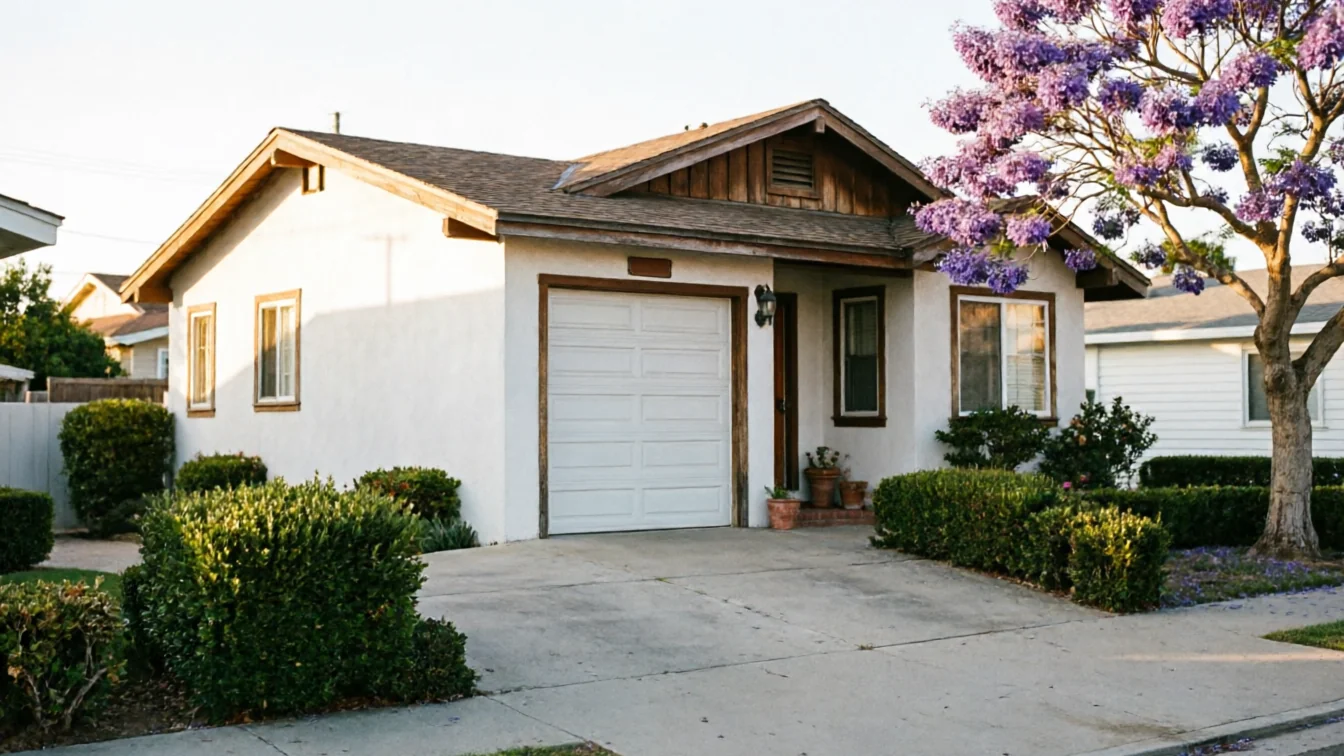
You're not paying for a truck to show up. You're paying for someone who knows what's behind the panel before they open it. Most houses in this area were built between 1938 and 2007, with the median landing around 1972, so a huge share of the doors we open are original torsion spring setups - steel tracks, steel panels, hardware that was never meant to be touched by anyone but the installer who hung it.
That matters because a wrong spring size on a 1970s door doesn't just fail to work, it can put real force through a track that's been holding tension for fifty years. You pay for the diagnosis that catches that before it becomes a bigger job, and for parts matched to the actual door in front of us instead of whatever's generic on the shelf.
One honest limitation: if your opener's circuit board was discontinued by the manufacturer years ago, we can't manufacture a part that doesn't exist. At that point replacement is the only real option, and we'll tell you that instead of charging you for a repair that won't hold. With a median household income of $105,104 across the service area, most owners here choose to spend once on the right part rather than twice on a patch.
Garage door services


The area
The build pattern across the service area tells us more about a door than a homeowner's description usually can. Most of what we open is older stock, but newer construction mixes in on the edges, and the decade a street went up points straight at the likely failure.
Chino and the ground around it is mostly 1960s and '70s stock, spread across 39 named communities in the wider service area. That's not a guess - it's what shows up every week on the truck.
A door built in that window is almost always a one-piece or sectional steel panel on side-mounted torsion hardware, sized to openings that don't always match what's sold off the shelf today.
Housing age here ranges from 1938 up through 2007, so you'll also find newer tract construction mixed in on the edges, with insulated doors and modern extension-spring or torsion setups that behave very differently from the older stock. Knowing which decade a street was built in tells us more about what's wrong with a door than the homeowner's description usually does.
Across the broader area there are 221,746 owner-occupied houses out of 427,123 households total - a lot of garages, a lot of originals still running on hardware nobody's serviced since it went in.
Los Serranos sits about three miles west of Chino, and that pocket in particular still carries a lot of that older build.
What we find
Chino is home base, and the territory runs out from there in a ring measured by real drive distances rather than a marketing map. Here is how the towns stack up by distance, and why the moderate climate across the stretch works in a homeowner's favor.
Our base is Chino, and the territory runs out from there in a ring that follows real distances, not a marketing map.
Eastvale is about 4 miles out, Chino Hills around 5, and Los Serranos sits 3 miles to the west. Norco and Montclair are both roughly 7 miles away, Diamond Bar about 9, and Claremont and Jurupa Valley around 11.
Farther out we reach La Verne, Walnut, San Antonio Heights, El Cerrito, and Brea, all around 12 miles, then Placentia, Rowland Heights, and El Sobrante near 13 to 14 miles.
Villa Park, South San Jose Hills, Covina, and West Covina sit in the 14-to-15-mile range, with Bloomington, Glendora, Silverado, Valinda, La Habra Heights, North Tustin, La Habra, Vincent, La Puente, Woodcrest, and Hacienda Heights stretching out to 16, 17, and 18 miles.
The climate across this whole stretch runs moderate on the heat scale, which is kinder to garage door hardware than a lot of inland regions - less of the extreme thermal cycling that cracks plastic rollers and warps steel panels elsewhere.
How we work
Before anyone drives out, we ask enough on the phone to narrow down what's wrong, because the symptom usually points straight at the part. On site we look at the actual hardware before quoting, and we tell you honestly whether a door is worth fixing or has earned its retirement.
You call, you describe what the door's doing - won't open, makes a bang, stuck halfway, opener runs but nothing moves - and we ask a few questions that narrow it down before anyone drives out. A door that won't budge and makes a loud pop beforehand is almost always a broken torsion spring. A door that opens but drifts back down is usually a cable or a spring that's lost tension, not the opener.
Once we're at the house, we look at the actual hardware before quoting anything. On a lot of the older stock in this area that means checking whether the torsion bar, drums, and cables match the door's actual weight, since plenty of these doors have had panels replaced over the decades without anyone re-balancing the spring to match.
We tell you what's wrong, what it takes to fix it, and whether it's worth fixing at all. Some older doors have earned their retirement - if the panels are rusted through or the track is bent past straightening, we'll say so instead of bolting on another patch.
Good to know
Broken torsion springs lead the list, by a wide margin, on doors from that 1960s-to-70s build window - the springs simply age out after enough open-close cycles, and on a double door the second spring usually isn't far behind the first. Right behind that: openers from the same era, or their later replacements, that have worn through the drive gear or the logic board.
We also see a steady run of cable failures on original hardware, rollers that have gone brittle, and tracks knocked out of alignment, often from a car bumping the door more than once over the years rather than one dramatic hit. Panel damage shows up less often but tends to be worse when it does, since a dented steel panel from the '70s doesn't flex back the way newer material can.
What we don't see much of, given the moderate heat band this area sits in, is the kind of thermal warping that plagues doors in harsher climates - panels staying straighter, plastic parts lasting longer. That's one advantage of the local climate that works in a homeowner's favor here.

Towns we serve
Questions
A lot of the housing in this area went up in the 1960s and '70s, and torsion springs in that generation of doors are simply reaching the end of their cycle life at close to the same time. We see the same failure, broken torsion spring on a double door, more than any other call.
Sometimes, yes. If the panels are rusted through or the track is bent past straightening, replacement makes more sense than another repair. We'll tell you honestly which situation you're in before we quote anything, rather than patching a door that's past its useful life.
Yes. We cover a ring of communities from Los Serranos, 3 miles west, out through Eastvale, Chino Hills, Norco, Montclair, and farther towns like Diamond Bar, Claremont, and Brea, up to around 18 miles out.
This area sits in a moderate heat band, which is easier on garage door hardware than harsher inland climates. Steel panels and plastic rollers here see less of the thermal cycling that cracks and warps parts elsewhere, so doors tend to hold up a bit longer before needing panel or roller work.
Ready when you are
Chino Garage Door Co repairs and installs garage doors, springs and openers in Chino, CA and the surrounding area.